
Water and Energy Project
2022 Water Usage Results
February 2024
Table of Contents
- Introduction
- Methodology
- 2.1 Development of the Data Collection Tool
- 2.2 Scope of the Data Collection
- 2.3 Participation
- 2.4 Data Quality and Notes
- Water Use Intensity
- 3.1 Drenching
- 3.2 Dedicated Presort Water Use Intensity
- 3.3 Dedicated Packing Line Water Use Intensity
- 3.4 Hybrid Line Water Use Intensity
- 3.5 Cold Storage
- 3.6 Ablutions, Canteens & Offices Water Use Intensity
- 3.7 Overall Packhouse Water Use Intensity
- Water Usage Profiles
- 4.1 Results
- Water Sources
- Year-on-Year Comparison of Water Use Intensities
- Water Management Practices
- 7.1 Flume Technology Age
- 7.2 Flume Water Management
- 7.3 Water Saving and Water Treatment Methods
- Conclusion
- Recommendations
Introduction
In 2017, Blue North Sustainability (Pty) Ltd. (Blue North) was contracted by the Packhouse Action Group (PAG) to conduct a study on water risks and provide water consumption benchmarks for pome fruit packhouse and cold storage operations. Since then, four more phases of benchmarking have been completed (2018–2021).
This report concludes the sixth phase, covering data from January to December 2022. The objectives were to:
- Replicate the water use benchmark study from previous phases
- Increase packhouse participation
- Provide a year-on-year comparison of water use in packhouse and cold storage operations
- Collect data on preventative maintenance
- Collect categorised data on water management practices
- Simplify the data collection where possible
This report presents the results from Phase 6 (2022 data), compares them to previous phases, and summarises water management and recycling methodologies.
Electricity consumption results are available in a separate report.
Methodology
2.1 Development of the Data Collection Tool
- Data was collected and sense-checked by the project team.
- Data anomalies were discussed and rectified or explained.
- Updates for Phase 6:
- Additional fields for hybrid pack line water use
- Replacement of free text fields with checkboxes for user-friendliness
Participants were also invited to share their water management SOPs (standard operating procedures).
2.2 Scope of the Data Collection
Five areas in pome fruit packhouses were isolated for water consumption:
- Drenching: Water used for drenching fruit or bins
- Dedicated presort: Water for dedicated presorting lines
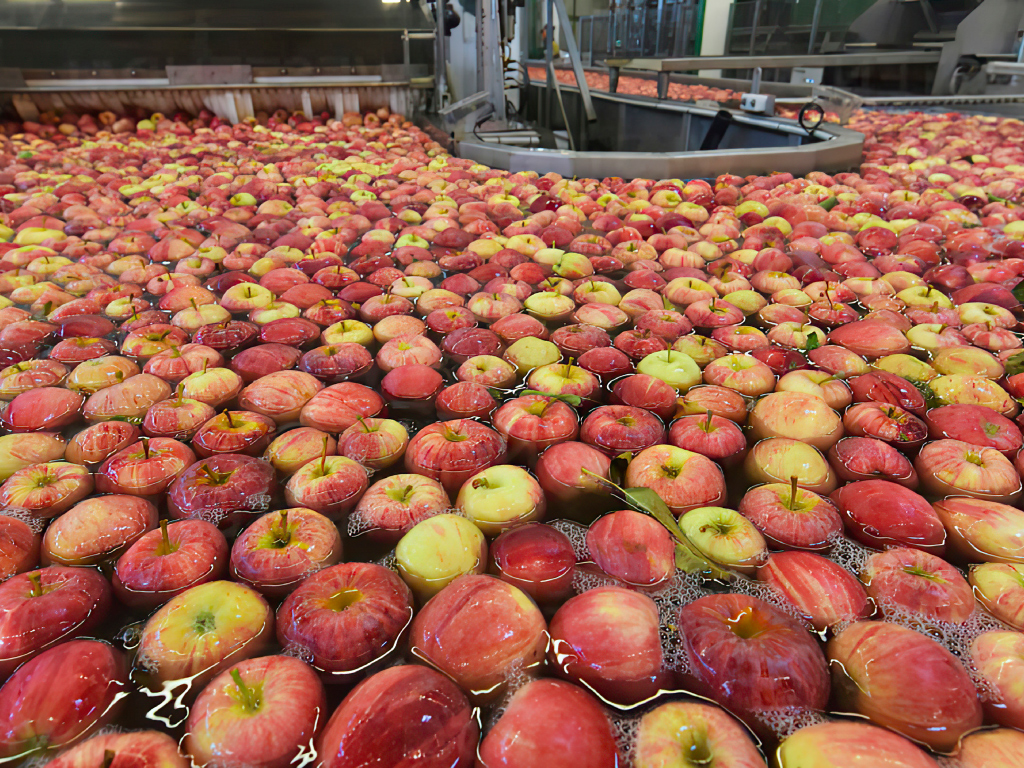
- Packing lines: Water for packing lines (mainly flume water)
- Hybrid line: Water for lines where presort and packing occur simultaneously
- Cold storage: Water for Regular Atmosphere (RA) and Controlled Atmosphere (CA) facilities (mainly cooling towers)
- Ablutions, canteen & offices: Staff water consumption
2.3 Participation
- 22 packhouses invited; 12 provided data
- 3 have participated since the first phase
- 3 are new to the project
- Main reasons for non-participation:
- No metering or data
- Limited resources for data capturing
- No interest
No packhouses shared a water management SOP.
2.4 Data Quality and Notes
- All datasets correspond to the 2022 calendar year.
- Packhouses are anonymised (A to Q).
- Most packhouses cannot allocate water use by area due to lack of separate meters.
- Some packhouses have no meters and provided only estimates or qualitative data.
Table 1: Summary of Packhouse Data Quality
| Packhouse | Drenching | Dedicated Presort | Dedicated Packing | Hybrid | Cold | Ablution |
|---|---|---|---|---|---|---|
| A | Metered | Metered | Metered | Metered | Metered | Metered |
| B | Metered | N/A | Metered | N/A | Metered | Metered |
| C | N/A | N/A | Estimated | N/A | Estimated | Estimated |
| D/E/F/J/N | Did not participate in Phase 6 | |||||
| G | No data | N/A | Metered | N/A | Metered | Estimated |
| H | Estimated | N/A | Estimated | N/A | Estimated | Estimated |
| I | No data | Estimated | Estimated | N/A | Estimated | Estimated |
| K | No data | No data | No data | N/A | No data | No data |
| L | N/A | Estimated | Estimated | N/A | Estimated | Estimated |
| M | Metered | Estimated | Metered | Metered | Metered | Estimated |
| O | No data | N/A | Estimated | No data | No data | No data |
| P | N/A | Estimated | Estimated | Estimated | Estimated | Estimated |
| Q | No data | N/A | No data | N/A | No data | No data |
- Most packhouses cannot allocate water use by area due to lack of separate meters.
- Some have no meters and provided only estimates or qualitative data.
Water Use Intensity
3.1 Drenching
- Calculation (per tonne):
Drenching water consumption (m³) x 1,000 / Tonnes of pome fruit drenched - Calculation (per bin):
Drenching water consumption (m³) x 1,000 / Number of pome fruit bins drenched - Some packhouses do not drench. Water use varies due to metering inaccuracy and different drenching protocols.
3.2 Dedicated Presort Water Use Intensity
- Calculation:
Presort water consumption (m³) x 1,000 / Tonnes of pome fruit for dedicated presort line - Only packhouses with dedicated presort lines included; most values are estimated.
3.3 Dedicated Packing Line Water Use Intensity
- Calculation:
Dedicated packing line water consumption (m³) x 1,000 / Tonnes of pome fruit packed - Many values estimated due to insufficient metering.
- Packing line is a major water consumer; lack of metering is a concern.
3.4 Hybrid Line Water Use Intensity
- Calculation:
Hybrid packing line water consumption (m³) x 1,000 / Tonnes of pome fruit packed - Hybrid line values are based on estimates.
3.5 Cold Storage
- Calculation:
Cold storage water consumption (m³) x 1,000 / (CA & RA tonne.days) - Tonne.day = 1 tonne stored for 1 day.
- Water use varies widely due to different storage protocols and metering quality.
3.6 Ablutions, Canteens & Offices Water Use Intensity
- Calculation:
Ablutions, canteens & offices water consumption (m³) x 1,000 / Staff man-days - Values above 50 litres/person/day are considered high.
- Potential for improvement through awareness, training, and recycling technology.
3.7 Overall Packhouse Water Use Intensity
- Incorporates all sections except “other” (e.g., housing, gardening).
- Unit: kL (or m³) per tonne of pome fruit packed.
- Metered packhouses consumed just below 1.5 kL/tonne in 2022.
- Large variation due to different water management practices.
Water Usage Profiles
4.1 Results
- Cold storage is the largest water consumer in most packhouses.
- Large variation in profiles due to:
- Lack of metering
- Water allocation issues
- Record errors
- Different flume technologies and recycling practices
Water Sources
- Largest volumes obtained from dams and boreholes; municipal water is third.
- Figures show total volumes per source and breakdown per packhouse.
Year-on-Year Comparison of Water Use Intensities
- Year-on-year comparisons are valuable for tracking trends.
- Only packhouses with more than two years of data included.
- Most packhouses show a downward or neutral trend in packing line water intensity.
- Cold storage water use increased at some packhouses; data quality is key.
- Staff water use shows mixed trends; improvements possible with water-saving measures.
Water Management Practices
7.1 Flume Technology Age
- Flume technology age is split between more and less than ten years old.
7.2 Flume Water Management
- Most packhouses monitor pH and chlorine levels; some use ORP.
- Flume water is typically drained weekly; some less frequently.
- Efficient drainage and refill cycles can save significant water.
7.3 Water Saving and Water Treatment Methods
- Flume water: Most packhouses discharge to earth dams; some reuse for irrigation/firefighting.
- Rainwater: Some packhouses harvest rainwater, but many do not use it.
- Drenching: Recycling technologies include perforated grids and sand filters.
- Presort/packing line: Sand filters and UV treatment are common.
- Cold storage: Some use recycling technologies.
- Ablutions/canteens/offices: Recycling is rare; some use rainwater tanks or sewage treatment.
- Wastewater treatment: Methods vary; some use silver bromide solution.
Conclusion
- Phase 6 shows encouraging engagement and promising trends in water use efficiency.
- Participation is growing, but barriers remain (metering, data collection capacity).
- Year-on-year data is increasingly valuable as the database grows.
- Water reuse, alternative sources, and waste reduction are being implemented, but more accurate data is needed to quantify impact.
- SOPs for water management are not widely used or shared.
Key concerns:
- Incomplete metering
- Limited data collection capacity
- Underutilisation of renewable water sources (e.g., rainwater harvesting)
Recommendations
For Future Project Phases
- Analyse metering and data recording challenges to inform targeted support.
- Encourage sharing of ongoing and planned water-saving initiatives.
- Solicit feedback to refine the data collection tool and process.
- Launch an industry-wide metering campaign or standard.
- Implement a “Water Heroes” recognition program for excellence in water use.
For Packhouses
- Implement consistent water consumption record-keeping with accurate meters.
- Allocate water use per activity or area for better accuracy.
- Establish a formal water policy and management plan.
- Set achievable water reduction targets.
- Train staff on water-wise behaviour.
- Explore and use alternative water sources (rainwater, treated wastewater).
- Reuse water wherever possible (e.g., floor cleaning, ablutions, cooling towers).
- Treat and reuse wastewater to minimise freshwater use.
- Optimise cooling tower operation (e.g., automated bleeding).
- Extend retention times for drenching/flume water.
- Regularly inspect and repair leaks and faulty equipment.
- Install water-efficient technologies (flow restrictors, tap aerators, auto shut-off valves).
By following these recommendations, packhouses can significantly improve water use efficiency and contribute to a more sustainable fruit industry.